
UMBC Interdisciplinary CoLab: Paid Narrative-based Internship
CoLab is an in-person, paid summer internship in narrative-based research for UMBC undergraduates. Held during Summer Session I, student interns will work on interdisciplinary project teams to conduct research, create effective narratives, and develop public-facing final products that support the goals of on and off campus community-engaged organizations and scholars. Open to all majors, this is an excellent opportunity for students in STEM fields to learn to tell effective stories and for students in social science and humanities fields to gain research and technical skills.
Participants who complete the internship receive a $3000 stipend and a tuition scholarship for the 3-credit internship course.
Program Dates
CoLab 2026 will be held during Summer Session I and meets in-person from Monday, June 1st through Friday, June 26th. PLEASE NOTE: During these dates, student interns are required to dedicate Monday through Friday from 9:30 am – 4:00 pm to the in-person, on-campus internship. Participants will have preparatory work to complete on their own the week prior to the in-person start date of 6/1, and a final reflective paper to submit the week following the final in-person date of 6/26.
Summer 2026 Projects
1. Stories from Historic East Towson along the Road to Freedom Trail
Project Leaders:
Dr. Charlotte Keniston, Shriver Peaceworker Fellows Program & Community Leadership Masters and Certificate Program
Dr. Bev Bickel, Language, Literacy, and Culture doctoral program
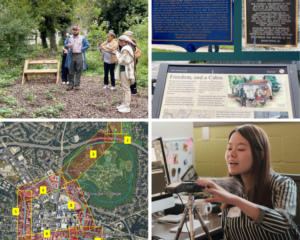
Historic East Towson is the last remaining Descendant community of the once massive Ridgely Estate, one of the largest plantations in Maryland. Its farm and mansion remain on the land now designated as the Hampton National Historic Site (NHS). Many of Historic East Towson’s residents have ancestors who were enslaved by Maryland’s 15th governor, Charles Carnan Ridgely. One of those direct descendants is Nancy Goldring, who is leading an ambitious project, The Road to Freedom Trail, a roughly 3.5 mile-long pedestrian and cycling trail which connects Historic East Towson via Goucher College (once the Epsom Plantation) and various sites throughout Towson to Hampton NHS. The trail will tell the stories of the history of bondage through enslavement and erasure, stolen land and stolen labor, environmental degradation and encroachment, the universal quest for freedom, and cultivating community and interconnectedness across time and place.
Students selected to join this CoLab project team will have the unique opportunity to engage in inter-generational conversations with East Towson Residents and create a set of digital stories that tell the story of Historic East Towson, its connections to Hampton NHS, and the current Road to Freedom Trail project.
Recommended skills, abilities, and interests for applicants:
Student members of the interdisciplinary team should share the following traits: Interest in oral history and digital storytelling, strong written and oral communication skills, leadership ability, and an interest in interacting with and supporting community members to tell their stories. Experience in the following are also encouraged: audiovisual production, digital storytelling, or simple animation used in video production.
Please Note: In order for students to have an engaging experience and to be proximate to community leaders, students must be willing to travel to Historic East Towson some of the days of the program (we will work out the specific days together at the start of the project).
2. Trashy Data: Making Sense of the Mr. Trash Wheel Family’s Haul
Project Leaders:
Dr. Rebecca Williams, Computer Science and Electrical Engineering
Dr. Sarah Jewett, Learning Partnerships-Research/Practice Honors College
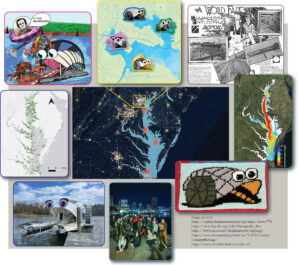
Who is Mr. Trash Wheel? Mr. Trash Wheel is described as a trash interceptor, a social media celebrity, and a Baltimore landmark. He depends on a blend of solar and hydro power to collect 500 tons of litter and debris in the water before they end up in the Chesapeake Bay and/or the Atlantic Ocean. The collected data derived from the trash hauls help to inform ecological understandings, vital legislation, and local practice. Mr. Trashwheel is a program of the Waterfront Partnership of Baltimore, a non profit organization that seeks to enhance waterfront public spaces, provide equitable access to blue/green spaces, and foster a healthy harbor.
What will our team do? In collaboration with Waterfront Partnership (WP), the CoLab team will use ArcGIS StoryMaps to create an interactive, narrative map that explores how trash accumulation at four Mr. Trash Wheel sites around Baltimore’s waterways relate to rainfall and river/stream flow into the Chesapeake Bay. The public-facing StoryMap will combine maps, charts, art, and text in ways that explain how “our streets are our streams,” in which rainfall events drive trash movement into the Baltimore Harbor and the Chesapeake Bay. To celebrate the social and cultural impact of the Mr. Trash Wheel Family and to humanize the data in impactful ways, we plan to incorporate community-created fan art into the StoryMap and potentially allow visitors to explore and create their own digital trash art.
Recommended skills, abilities, and interests for applicants:
All students should have a lively interest in working with data in creative, engaging, and public-facing ways. More specifically, we are seeking students who can bring one or more of the following: skills in and understandings of graphic design in sociocultural context; knowledge about how to create and organize media (texts/visuals) to communicate with and engage public audiences; familiarity with Python, ArcGIS, and/or StoryMaps; confidence in using raster and vector data; familiarity with Reactive programming and data visualization; and experience using libraries for research.
3. One Maryland, One Book: A Collaboration with Maryland Humanities
Project Leader: Dr. Lindsay DiCuirci, English
Student interns will work with Maryland Humanities, an educational nonprofit organization, on the production of the 2026 One Maryland, One Book (OMOB) Reading and Discussion Guide and Book Kits. The OMOB program encourages all Maryland readers to engage with the same book over the course of the year, creating a shared reading and enrichment experience. The 2026 selection will center the theme “Revolution, Reaction, Reform” in acknowledgement of the 250th anniversary of the Declaration of Independence. Focused on telling Maryland stories and featuring Maryland authors, this initiative includes an author tour, public events, book clubs, and educational programming.
The interdisciplinary team will create the digital and print materials, activities, and book kits for this year’s OMOB selection. Students will conduct research on Maryland historic sites, events, archives, and other contexts that will help the book come alive for readers of all ages. This OMOB selection and the materials produced by CoLab students will be featured throughout 2026-2027 in Maryland Humanities programming and will be read and used across the state, from book clubs to libraries, classrooms to living rooms.
Recommended skills, abilities, and interests for applicants:
Student members of the OMOD team should possess strong research skills and the ability to write for a general public across age groups. The following are also encouraged: interest or experience in Maryland history and literature, education, literacy, libraries, and/or non-profit work; experience with WordPress, web and print media design, copyediting, as well as social media management and/or public programming.
4. Tracing Korean American Lives in the Region: Archival Foundations for Local Community History
Project Leader: Dr. Kyung-Eun Yoon, Modern Languages, Linguistics, and Intercultural Communication (MLLI)

This CoLab project invites students to participate in a community-engaged research initiative documenting the history of Korean Americans in the Baltimore region in collaboration with the Howard County Historical Society (HCHS). Founded in 1958, HCHS serves as the primary institution dedicated to collecting and preserving historical records and artifacts related to the history of Howard County. While the Korean population in the area is substantial and plays a significant role in its multicultural landscape, HCHS currently has no well-established archive or collection representing their presence, contributions, and stories.
Working closely with the faculty project leader and HCHS staff, students will collaboratively produce historically grounded narratives for a general audience and contribute to an initial searchable inventory within HCHS’s collection database. The team will conduct hands-on archival and historical research using curated sources that trace Korean American life in the region through the early 2000s, some of which are written in Korean.
The project provides students with practical experience in archival research, public humanities, and community collaboration while contributing to the long-term preservation of local history.
Recommended skills, abilities, and interests for applicants:
Student members of the interdisciplinary team should share the following traits: intellectual curiosity, solid research skills, interest in archival research, strong written and oral communication skills, interest in regional history (including Korean immigration history), ability to work both independently and collaboratively, and a willingness to lead sections of the project.
Additionally, we are looking for one or more students with the following skills and interests: data-related skills, including experience with or interest in learning research databases and archival software (such as PastPerfect); competence in Korean to support translation and summary writing (and possibly to talk to community members who may be more comfortable using Korean).
5. Reporting on Economic Justice
Project Leader: Prof. Deborah Rudacille, English

Founded in 2000, Economic Action Maryland Fund (formerly Maryland Consumer Rights Coalition) is a multi-racial, people-centered movement to expand economic rights, housing justice and community reinvestment for working families, low-income communities, and communities of color.
Economic Action provides direct assistance to clients in addition to lobbying to pass legislation to create systemic change. At present, the organization is focused on identifying the most pressing economic challenges faced by residents of the state and documenting and sharing their stories via social media reels, videos, and infographics.
Our interdisciplinary team will contact Economic Action clients and conduct interviews focused on the issues identified in EA’s 2025 survey of Maryland residents. The stories (video and infographics) will be featured on Economic Action Maryland’s website, Facebook and Instagram accounts, YouTube channel, and Bluesky. The stories gathered by our UMBC CoLab team will also be shared with Maryland state and federal elected officials.
Recommended skills, abilities, and interests for applicants:
We are looking for students interested in using social media as a means of creating awareness and action on issues of social and economic justice. Experience working or studying public policy and the intersection of racial equity and economic justice would also be useful. At least one member of our team should have basic reporting/interviewing skills. At least one student should have experience in filming and editing videos, reels, and other multi-media skills. Experience with Canva or other apps for creating infographics would be most helpful.
Application requirements
- To apply, you must be a UMBC degree-seeking undergraduate student, have completed at least 30 credits at UMBC, and you must submit an unofficial UMBC transcript with your application. Transfer students who have completed at least one semester of coursework at UMBC and at least 30 total college credits may apply and include their transcript from their previous college or university.
- Your transcript must indicate that your UMBC cumulative grade point average is 3.20 or greater.
- The review committee will only consider applications that meet the minimum qualifications and requirements. However, selection for this internship is competitive; therefore, meeting the minimum qualifications does not guarantee your selection.
- You must complete the full application and answer all questions.
The Application is now open and closes at 8pm on Wednesday, March 25, 2026.
Want to see more CoLab? Learn more about the program and look at what past students accomplished during their internships! See Past Projects.
Questions
Please contact Dr. Rachel Carter at rachc1@umbc.edu.
The UMBC Interdisciplinary CoLab program is a partnership between The Office of Summer, Winter & Special Programs; the Dresher Center for the Humanities; and the Provost’s Interdisciplinary Activities Advisory Committee.